
The Psychology of Giving Up
If a person observes themselves honestly over a period of time, especially during moments when they are trying to change something in their life, they begin to notice a pattern that is difficult to ignore, and that is the strange inconsistency between what they decide and what they actually do, because even when a decision is logical, well thought out, and genuinely important, there is often a moment later when that same decision feels less convincing, less urgent, or somehow easier to ignore.
This experience is so common that many people simply accept it as part of their personality, often describing themselves as “undisciplined” or “inconsistent,” but this interpretation misses something much more important, which is that the conflict is not random and it is not a flaw, but rather the result of how the brain is designed to operate.
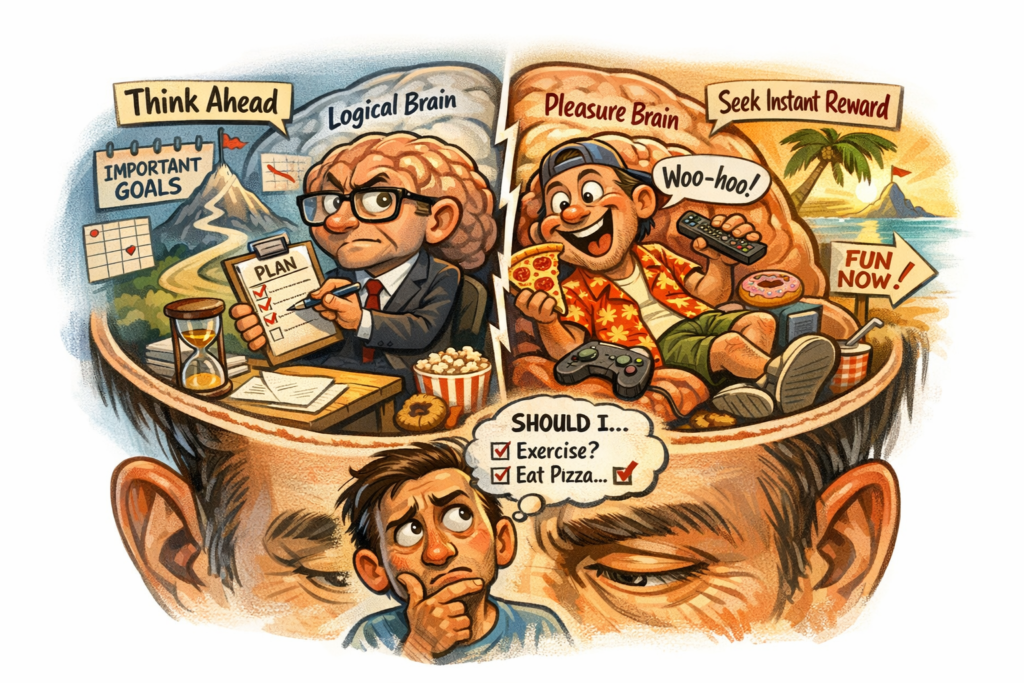
At a functional level, the human mind is not a single voice making decisions, but a system in which different processes operate at the same time, each with its own priorities, and the most important of these, when it comes to behavior, is the difference between the part of the brain that plans for the future and the part that responds to immediate reward.
One part of you is capable of stepping back, evaluating consequences, and deciding that certain actions, even if they are not immediately enjoyable, are necessary in order to achieve something meaningful over time.
Another part of you is not concerned with long-term outcomes in the same way, because its primary function is to respond to what feels rewarding right now, to avoid unnecessary effort, and to conserve energy whenever possible.
These two processes are not in conflict by design, but they often become misaligned in modern life, and when that happens, behavior begins to feel inconsistent.
The Dopamine System — Why Your Brain Prefers What Feels Easy
To understand why the “pleasure side” of the mind feels so powerful, it is necessary to look at how the brain processes reward, and here the concept of dopamine becomes essential, not in a complicated medical sense, but in a very practical way.
Dopamine is often described as the chemical of pleasure, but in reality, it functions more like a learning signal that tells the brain what actions are worth repeating, and every time you experience something that feels rewarding, the brain releases dopamine and strengthens the connection between that action and the positive outcome.
Over time, this creates a very efficient system in which the brain begins to prioritize behaviors that produce quick and reliable reward, because from a biological perspective, this is the safest and most energy-efficient strategy.
The important detail here is that the brain does not evaluate these actions based on their long-term value, but based on how immediate and accessible the reward is.
So when you compare two actions:
- One gives immediate satisfaction with almost no effort
- The other requires effort and delays reward
The brain will naturally lean toward the first option, not because it is irrational, but because it is functioning exactly as it was designed to.
This is why many of the behaviors that interfere with long-term goals feel easy and natural, while the behaviors that support those goals feel heavier and less appealing at the beginning.
Neuroplasticity — Why Change Feels Unnatural at First
At the same time, the brain is not fixed, and this is where neuroplasticity becomes relevant, because it explains why change is difficult at first, but becomes easier with repetition.
Neuroplasticity simply means that the brain adapts to what you do repeatedly, strengthening the pathways associated with those behaviors and making them more automatic over time.
If a person has spent years choosing comfort, reacting to emotions, or postponing effort, those patterns become deeply embedded, and the brain becomes very efficient at executing them.
When that same person suddenly tries to introduce new behaviors, such as consistent training, structured routines, or delayed gratification, they are not starting from zero, but from a system that has already been trained to operate differently.
This is why the new behavior feels unnatural.
Not because it is wrong.
But because it is not yet familiar.
The brain has not built the pathway for it yet.
And building that pathway requires repetition.
How the “Pleasure Side” Influences Behavior
When you begin to move in a direction that requires effort and consistency, the part of your brain that is responsible for immediate reward begins to respond in predictable ways, and these responses are often experienced as thoughts that feel logical, even convincing, but are in fact attempts to redirect behavior toward easier alternatives.
These patterns are not random, and once you recognize them, you begin to see that they follow a structure.
1. It questions the idea itself
At the very beginning, the resistance appears as doubt about the action.
You may notice thoughts such as:
- “This is too difficult.”
- “This is more complicated than it needs to be.”
- “This will take too long.”
What is happening here is not a rational evaluation of the situation, but a protective mechanism, because the brain is interpreting effort as something inefficient and is trying to preserve the current state.
2. It reduces the value of success
If the idea itself is not rejected, the next step is to make the outcome seem less desirable.
You may begin to think:
- “People who do this are not actually happier.”
- “This kind of lifestyle is boring.”
- “It is not worth giving up comfort for this.”
This is a subtle shift, but it is very effective, because if the reward appears less valuable, the brain no longer sees a reason to invest effort.
3. It makes it personal
At this stage, the focus moves from the action to the individual.
The thoughts become:
- “This is not for me.”
- “I am not built for this.”
- “I will not be able to maintain it anyway.”
Here the brain is using past experience to predict future outcomes, and although this may feel accurate, it is often based on incomplete or outdated information.
4. It redirects attention
When resistance cannot stop the action directly, it begins to shift attention.
Suddenly, other things feel more important:
- “I should take care of something else first.”
- “I am too tired right now.”
- “I need a break.”
This is the brain moving toward easier sources of reward, not because they are more important, but because they are more accessible.
5. It postpones action
If all else fails, the action is not rejected.
It is delayed.
- “I will start tomorrow.”
- “I need better conditions.”
- “This is not the right moment.”
This is one of the most effective forms of resistance, because it allows the intention to remain while removing the need for immediate effort.
Why This Leads to Giving Up
When these patterns repeat over time, they gradually weaken consistency, not through a single failure, but through small, repeated deviations from the original plan.
The person does not feel like they are quitting.
They feel like they are adjusting.
But the effect is the same.
The behavior becomes unstable.
The progress slows.
And eventually, the system collapses.
This is why giving up often feels confusing, because it does not happen suddenly, but gradually, through a series of small decisions influenced by how the brain processes reward and effort.
Written by Alexander Babinets
Founder of Express Fitness, certified coach, and author helping people get in shape without excuses.
📍 expressfitness.ca | 📩 info@expressfitness.ca
👤 More about me → alexanderbabinets.com
THIS IS THE CHAPTER FROM MY NEW BOOK: NO EXCUSES FITNESS: Why Motivation Fails and What Actually Works