
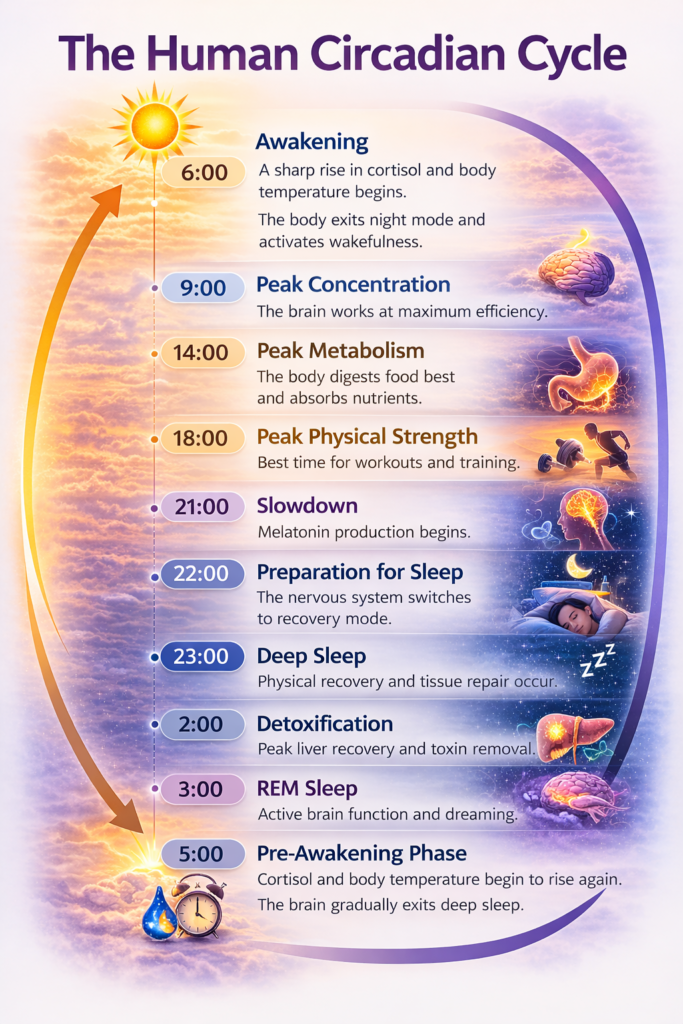
Sleep as a Regulator of the Nervous System
For a long time, sleep was viewed as a passive state—a simple reduction of activity, a pause between periods of wakefulness. Modern neuroscience, however, tells a very different story. Sleep is not a shutdown of the brain but an active and highly organized biological process. Without it, emotional regulation cannot stabilize, pain thresholds cannot normalize, metabolism cannot rebalance, and neural plasticity cannot be maintained.
In the context of chronic stress and central sensitization described in previous chapters, sleep becomes one of the most fundamental mechanisms through which the nervous system redistributes excitation and inhibition. When sleep is disrupted, it does not merely appear as a secondary symptom. It becomes a central driver of the pathological process itself.
Circadian Architecture and Hormonal Rhythm
Human biological rhythms are coordinated by the suprachiasmatic nucleus of the hypothalamus, which synchronizes hormonal, metabolic, and behavioral processes with the twenty-four-hour cycle of light and darkness.
One of the key hormones regulated by this internal clock is cortisol, a central component of the body’s stress-response system. Under normal circumstances cortisol reaches its peak in the early morning, helping mobilize energy and initiate wakefulness. As the day progresses, cortisol gradually declines. This evening reduction allows the parasympathetic nervous system to become more active and permits the release of melatonin, the hormone that signals the body to prepare for sleep.
Under chronic stress, this rhythm begins to break down. Evening cortisol levels remain elevated, the morning peak becomes flattened, and the melatonin signal weakens. As a result, the body loses its ability to enter a genuine recovery phase. A person may feel exhausted, yet remain unable to fall into deep sleep. The body demands rest, but the nervous system remains on alert.
The Stages of Sleep and Their Regulatory Roles
Sleep unfolds in a series of stages, each with distinct biological functions.
Slow-wave sleep, especially its deepest stages, is characterized by a slowing of heart rate, a reduction in blood pressure, and intense tissue repair. During this period the body increases secretion of growth hormone, restores energy reserves, and regulates immune activity.
REM sleep, in contrast, plays a crucial role in emotional processing and neural integration of experience. During REM sleep the activity of the noradrenergic system decreases significantly. This reduction allows the brain to revisit emotional memories without triggering the full stress response that originally accompanied them. In effect, the brain is able to “rewrite” emotional experiences.
When REM sleep is reduced or fragmented, anxiety tends to increase. The amygdala becomes more reactive, and anticipatory anxiety—the expectation that something bad will happen—becomes more likely.
The Molecular Biochemistry of Sleep
Sleep regulation is controlled not only by circadian signals but also by homeostatic mechanisms.
One of the key mediators involved in this process is adenosine. Throughout the day adenosine accumulates as a byproduct of cellular energy metabolism. Rising adenosine levels gradually create the sensation of sleepiness. Caffeine temporarily blocks adenosine receptors, which reduces the subjective feeling of fatigue. However, this does not restore the underlying regulatory processes that sleep normally provides.
Another critical component is gamma-aminobutyric acid (GABA), the brain’s primary inhibitory neurotransmitter. GABA reduces neuronal excitability and allows the brain to transition into sleep states. When the balance between GABA and excitatory neurotransmitters such as glutamate becomes disrupted, the nervous system may enter a state of persistent hyperactivation—a pattern frequently observed in chronic insomnia.
In contrast, the neuropeptide orexin (also known as hypocretin) promotes wakefulness. Under prolonged stress conditions orexin activity may remain elevated, making it more difficult for the brain to transition into deep restorative sleep.
The Glymphatic System: Nighttime Brain Cleansing
Recent discoveries have revealed the existence of the glymphatic system, a mechanism responsible for clearing metabolic waste products from the brain’s intercellular spaces. Among these waste products is beta-amyloid, a protein associated with neurodegenerative disease.
The glymphatic system becomes most active during deep sleep. At that time the spaces between brain cells expand, allowing cerebrospinal fluid to circulate more efficiently and wash away metabolic byproducts.
When deep sleep is chronically reduced, this cleansing process becomes less effective. Over time this can contribute to cognitive fog, reduced concentration, and mental fatigue.
Sleep and Pain Sensitivity
Experimental research demonstrates that even a single night of severe sleep deprivation can increase pain sensitivity the following day. This effect appears to be related to reduced serotonergic activity and decreased effectiveness of descending analgesic pathways that normally dampen pain signals.
Patients with fibromyalgia frequently display fragmented sleep patterns with reduced deep sleep. This disturbance contributes to the persistence of central sensitization.
Pain and sleep therefore create a bidirectional relationship. Pain disrupts sleep, and insufficient sleep amplifies pain.
Sleep and Metabolic Regulation
Sleep deprivation also affects metabolic processes. Reduced sleep alters insulin sensitivity, increases the hormone ghrelin, and decreases leptin, the hormone responsible for signaling satiety. The result is increased appetite and a tendency toward fat accumulation.
Increased insulin resistance further contributes to systemic inflammation, which may lower pain thresholds and intensify fatigue.
A Personal Experience of Insomnia
One individual described the gradual onset of insomnia in the following way:
“Insomnia entered my life slowly. At first I treated it as something temporary, something caused by fatigue or work stress. But after a few months I began to notice that the very expectation of night triggered tension.
I would lie down already thinking that I would not sleep again. That thought turned out to be stronger than any rational explanation. My heart began to beat faster. My breathing became shallow. My muscles remained tense, as if my body were preparing for a fight rather than for rest.
The next day I felt tired and slightly irritable, which made me anxious about the coming night. Medical examinations showed nothing abnormal, yet the feeling that my nervous system had lost the ability to switch off became stronger and stronger.
Eventually I began to fear the process of falling asleep itself. And that fear became the greatest obstacle to sleep.”
Sleep as a Regulator of Fear
Functional neuroimaging studies show that adequate sleep reduces the reactivity of the amygdala while strengthening regulatory control from the prefrontal cortex. Sleep deprivation has the opposite effect. Emotional responses become exaggerated and more difficult to regulate.
Sleep, therefore, is not merely a biological necessity. It is a critical mechanism for regulating fear.
Restoring Circadian Structure
Improving sleep requires restoring rhythm, not merely increasing duration.
Consistent wake-up times, reduced evening sensory stimulation, moderate physical activity, and cognitive decompression all contribute to stabilizing circadian architecture.
Even simple practices—such as reflecting on moments of gratitude before sleep—may reduce amygdala activation and strengthen parasympathetic tone through prefrontal modulation.
Sleep as the Foundation of Regulation
Attempting to treat chronic anxiety or persistent pain without stabilizing sleep is similar to reinforcing the walls of a building while ignoring its foundation.
The nervous system is capable of reorganization. But for that reorganization to occur, it requires the nightly biological reset that sleep provides.
CORE PRINCIPLE OF THE CHAPTER:
Sleep is an active regulator of neural plasticity, pain sensitivity, and emotional resilience. When sleep is chronically disrupted, it sustains the physiological mechanisms underlying chronic stress and central sensitization.
Written by Alexander Babinets
Founder of Express Fitness, certified coach, and author helping people get in shape without excuses.
📍 expressfitness.ca | 📩 info@expressfitness.ca
👤 More about me → alexanderbabinets.com
THIS IS A CHAPTER FROM MY NEW BOOK: 12 STEPS TO FREEDOM: Conquering DEPRESSION and Taking Back Your Life