
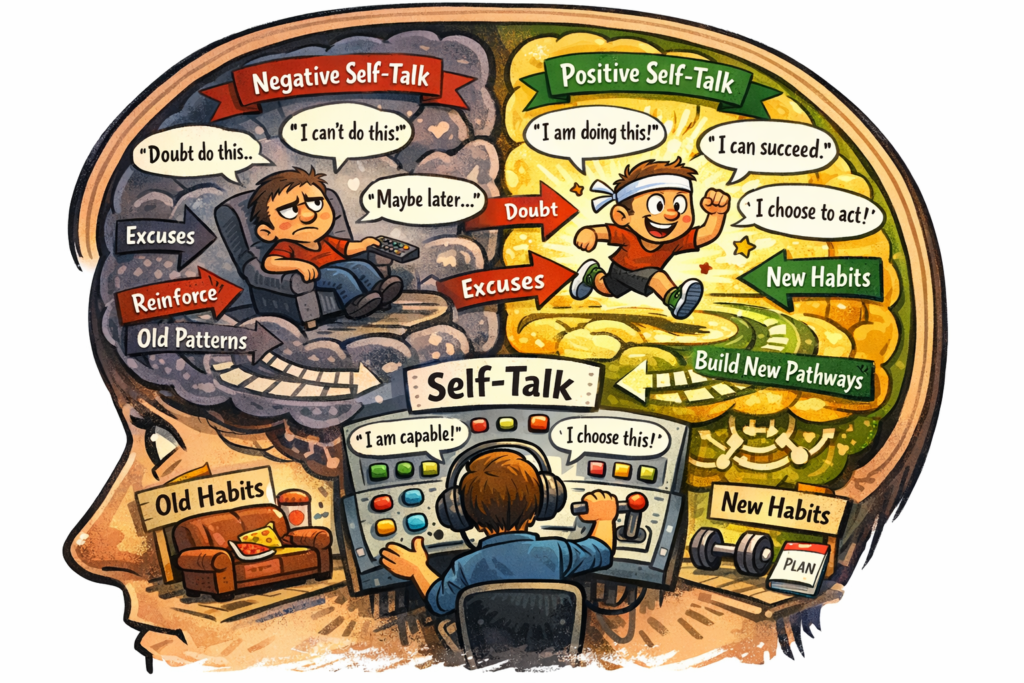
Self-Talk Is Not Just Thinking — It Is Conditioning
Every day, without exception, thousands of thoughts pass through the human mind, and although most of them appear insignificant, repetitive, or even unnoticed, they collectively shape our behavior in ways that are far more powerful than most people realize, because these thoughts are not just passive observations, but active signals that guide decisions, trigger actions, and reinforce habits over time.
What makes this process particularly important is the fact that thinking is not silent, even when it feels that way, because internally we are constantly communicating with ourselves, forming short statements, evaluations, and instructions that influence what we do next, and this continuous internal dialogue is what we refer to as self-talk.
It may sound simple at first, but in reality, self-talk is one of the most influential mechanisms in human behavior, because it sits exactly at the intersection between thought and action.
When a person thinks, “I am hungry,” the body begins to respond and the person moves toward food.
When a person thinks, “I am tired,” the body prepares for rest.
When a person thinks, “I will do this later,” action is postponed.
These are not random connections.
They are learned associations.
Self-Talk Is Not Just Thinking — It Is Conditioning
From a scientific perspective, self-talk can be understood as part of a conditioning system in which repeated thoughts strengthen specific behavioral patterns through reinforcement.
Each time a thought is followed by an action, the brain records the connection between the two.
Over time, this creates a loop:
Thought → Action → Reinforcement → Stronger Thought Pattern
This loop is supported by dopamine, which, as discussed earlier, acts as a signal that tells the brain which behaviors are worth repeating.
If a thought leads to an action that feels rewarding, even in a small way, the brain strengthens that pathway, making it more likely that the same thought will trigger the same action in the future.
This is how habits form.
Not because we consciously decide to repeat them.
But because the brain learns them through repetition.
Many of these patterns become automatic, meaning that we are no longer fully aware of the thoughts that trigger them, yet they continue to operate in the background, guiding behavior without requiring conscious effort.
This is what is often referred to as the “subconscious,” although in practical terms it is simply a collection of learned patterns that have become efficient.
Why Changing Habits Feels Difficult
When a person attempts to change their behavior, they are not simply making a new decision.
They are attempting to interrupt an existing loop and replace it with a new one.
This is where resistance appears.
Because the brain does not immediately abandon established patterns.
It protects them.
If a person is used to responding to stress with avoidance, or to boredom with entertainment, or to discomfort with postponement, those responses have been reinforced over time and have become efficient pathways.
Introducing a new behavior means asking the brain to use a weaker, less familiar pathway instead.
This feels uncomfortable.
Not because the new behavior is wrong.
But because it is not yet established.
The Role of Self-Talk in Rewiring Behavior
Self-talk becomes critical at this stage, because it is one of the few tools that allows conscious influence over automatic patterns.
However, in order for self-talk to be effective, it must follow certain principles that align with how the brain processes information.
These principles are not motivational tricks.
They are practical applications of how conditioning and attention work.
Rule 1 — The Brain Responds to Present-Oriented Signals
The brain operates primarily in the present moment, meaning that it responds more strongly to what is happening now than to what might happen later.
When a person says, “I need to go to the gym,” the statement is interpreted as a future intention, which allows the brain to remain in the current state.
If that current state is comfortable, the brain has no immediate reason to change it.
However, when the statement shifts to “I am going to the gym,” the brain receives a more immediate signal, which begins to compete with the current activity.
This difference may seem small, but it affects how the brain prioritizes action.
The key factor, however, is not just the wording, but the timing of the action that follows.
If the statement is not supported by immediate behavior, the brain learns that the thought does not lead to action, and the connection weakens.
If the statement is followed by action, even a small one, the connection strengthens.
Over time, repeated alignment between thought and action builds a new pathway.
Rule 2 — The Brain Does Not Respond Well to Negation
When a person tells themselves, “I am not going to do this,” the brain still processes the behavior being referenced, because attention is directed toward it.
This creates internal tension, because the desired outcome and the avoided behavior are activated at the same time.
From a neurological perspective, this is inefficient.
The brain prefers clear, singular signals.
For example:
- “I am not eating a cookie” keeps the focus on the cookie
- “I am eating something else” shifts the focus toward a different action
This distinction matters, because behavior follows attention.
If attention remains on the old habit, the pathway associated with that habit remains active.
If attention shifts to a new behavior, the brain begins to reinforce a different pathway.
This is why replacement is more effective than suppression.
The goal is not to eliminate behavior.
It is to redirect it.
Rule 3 — Specificity Reduces Internal Conflict
The brain processes information more efficiently when it is clear and specific.
Vague instructions require interpretation, and interpretation creates delay.
When a person says, “I should eat better,” the brain does not receive a clear action.
When a person says, “I am eating this meal,” the instruction becomes concrete.
This reduces hesitation and allows the brain to move toward execution.
Repetition of specific instructions strengthens the association between thought and action, gradually making the behavior more automatic.
Why Words Matter More Than They Seem
The language used in self-talk is not neutral, because it influences how the brain evaluates control and certainty.
Statements such as:
- “I have to”
- “I should”
- “I will try”
often imply obligation without full commitment, which can create resistance, because the brain interprets them as pressure rather than choice.
On the other hand, statements such as:
- “I choose”
- “I am doing this”
carry a different structure, because they frame the action as intentional rather than forced.
This distinction is important because perceived control affects motivation.
When the brain senses choice, resistance decreases.
When it senses pressure, resistance increases.
Why Self-Talk Alone Is Not Enough
It is important to understand that self-talk without action has very limited effect. The brain does not change based on words alone. It changes based on repeated experience. Self-talk provides direction. Action provides reinforcement. Without reinforcement, the pathway does not strengthen. This is why small, consistent actions are more effective than large, inconsistent efforts.
Because each repetition contributes to the rewiring process.
The Larger Picture — From Awareness to Control
When all of this is viewed together, it becomes clear that self-talk is not about motivation or persuasion, but about directing attention and behavior in a way that allows new patterns to form.
The process is gradual.
It requires repetition.
And it requires awareness of how thoughts influence actions.
Most importantly, it requires understanding that the mind is not something that must be controlled through force, but something that can be guided through consistent input and reinforcement.
Over time, as new patterns are repeated and reinforced, they become more stable, and behavior begins to align more naturally with intention.
At that point, the internal dialogue changes as well, not because it was forced to change, but because it adapted to support the new behavior.
Final Understanding
Where a person goes from their current state is not determined by a single decision or a single moment of motivation, but by the repeated interaction between thought and action over time.
No one else can control this process.
No external system can replace it.
Because the most consistent influence on behavior is the one that happens internally.
And that influence is shaped, moment by moment, by how a person speaks to themselves — and whether they act on it.
Written by Alexander Babinets
Founder of Express Fitness, certified coach, and author helping people get in shape without excuses.
📍 expressfitness.ca | 📩 info@expressfitness.ca
👤 More about me → alexanderbabinets.com
THIS IS A CHAPTER FROM MY NEW BOOK: NO EXCUSES FITNESS: Why Motivation Fails and What Actually Works